Complete vocabulary and grammar reference for HSK 5, under the new HSK 3.0 standard.
1,600
Total words at HSK 5
13
Grammar categories
15
Word types (parts of speech)
B2
Approx. CEFR equivalent
About this level: HSK 5 (新大纲 HSK 3.0) is an upper-intermediate level, building on the vocabulary and grammar of Levels 1–4. It introduces abstract vocabulary, formal/written registers, and more complex grammatical structures such as complements, fixed formats (固定格式), and complex sentences (复句).
How to use this page: Use the Vocabulary tab to search and filter all 1,600 words by Hanzi, Pinyin, or word type. Use the Grammar tab to review all 13 grammar categories, each with their grouped sub-points and example items as listed in the official outline.
Grammar Category Breakdown
HSK 5 Vocabulary
All 1,600 words for HSK Level 5 with Pinyin, English meaning, and part of speech, numbered in outline order.
#
HANZI
PINYIN
MEANING
TYPE
EXAMPLE SENTENCE
HSK 5 Grammar Points
All 13 grammar categories from the HSK 5 outline, with an explanation and example sentences for every point.
HSK 5 Sample Exam
Official specimen questions for HSK 5, based on the 2025–12 released “新版 HSK(1–6 级)考试结构与样题示例” (new-format HSK structure & sample questions), effective from July 2026.
Disclaimer: This content is compiled strictly for personal educational and study purposes. I do not claim ownership of this official exam material — all sample questions, images, and audio originate from the official HSK sample papers, and copyright belongs to chinesetest.cn (Center for Language Education and Cooperation).
Section-by-section tactics for the listening, reading, and writing parts of HSK 5, based on the official exam structure (35 min listening · 35 min reading · 40 min writing, 72 questions total).
听 1Listening Part 1 (Q1–19) · Short dialogue + question
Format: you hear one short exchange (or a monologue) and one question, then choose the correct answer from 4 written options (A/B/C/D). Audio plays once.
1Read the 4 options before the audio starts
While the instructions are playing (or in the gap between items), skim the four printed options. They tell you the topic in advance, so you know what to listen for — a place, a reason, an opinion, a number, etc.
2Listen for the last speaker's line and the question word
The correct answer is usually confirmed or corrected in the final line of the dialogue, not the first. Pay special attention to reversals introduced by 不过, 可是, 但是, 其实, or 别 — these often flip the expected answer.
e.g. 女:我们坐公交车去吧。 男:不用,我开车送你们。 → the answer is "by car", not "by bus".
3Match meaning, not exact wording
Correct options are almost always paraphrases of what's said, not verbatim quotes (e.g. 住院了 in the audio might appear as 生病了 or 身体不舒服 in the option). Don't discard an option just because the exact words weren't spoken.
4Never leave a blank
If you miss an item, mark your best guess immediately and move on. You cannot replay the audio, and dwelling on a missed question costs you the next one too.
听 2Listening Part 2 (Q20–35) · Longer dialogue/passage, 2–3 questions each
Format: a longer conversation or short narrated passage (often a story, interview, or news item) followed by 2–3 questions, each with 4 options.
1Pre-scan all questions for that passage at once
Since 2–3 questions share one audio clip, glance at all of them together beforehand so you know roughly how the passage will unfold (e.g. a cause, then an effect, then an opinion) and can track information for each question in parallel.
2Track the order of events/ideas as you listen
Questions are usually asked in the same order the information appears in the audio. If you're unsure about question 2, don't panic — keep listening, since question 3's answer will come right after.
3Jot down numbers, names, and turning-point words
Quickly note figures, proper nouns, and connectors like 虽然...但是, 不但...而且, 除了...还 as you hear them — these often signal exactly where an answer lives.
4For story/narrative passages, watch for the final takeaway
Passages about historical figures or life lessons (like 苏洵 or 范仲淹-style stories) often end with a "moral" or a summary of what someone achieved. A final question frequently asks about this outcome, so listen carefully to the last 1–2 sentences.
Common pitfall: Don't choose an option just because you heard the same word in the audio — distractor options often reuse a keyword out of context (e.g. audio mentions 医院 in passing, but the correct answer is about something else entirely).
读 1Reading Part 1 (Q36–45) · Cloze / choose the right word
Format: short passages with blanks; choose the correct word (often testing near-synonyms) from 4 options for each blank.
1Check part of speech first
Look at what comes immediately before/after the blank. If it needs a verb, eliminate the nouns and adjectives among the options right away — this alone often cuts your choices in half.
2Distinguish near-synonyms by collocation, not meaning alone
HSK 5 loves testing words that mean almost the same thing but pair with different collocates, e.g. 讲究 (to be particular about) vs 关注 (to pay attention to) vs 追求 (to pursue). Ask: "which word normally goes with this noun/verb?" rather than just "which word fits the general idea?"
3Use fixed structures and set collocations as anchors
Certain blanks are testing a fixed pattern (从而, 以及, 不仅...还, 由...组成). If you recognize the surrounding grammar frame, the correct word is often forced by the structure alone, regardless of subtle meaning differences.
4Read the whole sentence (or two), not just the blank's neighbors
Some blanks can only be resolved using information later in the sentence (e.g. a contrast word like 却 or 但 tells you the blank should have an opposite-leaning meaning to what follows).
读 2Reading Part 2 (Q46–55) · Sentence-order / paragraph reconstruction
Format: a short passage is broken into labeled sentence fragments (A–F); you place them into the correct blanks to reconstruct a coherent paragraph.
1Find the anchor sentence first
Look for one fragment that clearly must come first (introduces a topic/subject) or clearly must come last (a conclusion, e.g. starting with 因此, 总之, 如今). Fixing one "anchor" narrows down the rest.
2Use pronouns and demonstratives as glue
Words like 他、这、那、其中、这样 refer back to something already mentioned — they cannot open a passage and must follow the sentence that introduces the noun they refer to.
e.g. a fragment starting with "而回收利用后的收益" needs a preceding sentence that already introduced "回收" or "收益" as a topic.
3Match paired conjunctions across fragments
If one fragment contains 虽然, look for the fragment with 但是/却; if one has 一方面, look for 另一方面. HSK 5 often splits a paired-conjunction sentence across two of the lettered options.
4Read the finished paragraph once at the end
After filling all blanks, do a fast read-through. A logically broken paragraph (topic jumps, dangling pronouns) is a sign one placement is wrong — you can usually catch this in a few seconds.
读 3Reading Part 3 (Q56–70) · Passage comprehension
Format: longer passages (news items, stories, opinion pieces) each followed by 3–4 multiple-choice comprehension questions.
1Read the questions before the passage
Skim the questions (not the 4 options in detail) first, so you know what to hunt for — a cause, a number, an attitude, a definition. This turns a slow full read into a targeted search.
2Questions follow the passage's paragraph order
The answer to question 1 is typically found before the answer to question 2, and so on. Use this to narrow down which paragraph to search in, rather than re-reading the whole passage for each question.
3For "underlined phrase means..." questions, use context, not literal translation
These questions ask what a phrase (often an idiom or metaphor, e.g. "学而知不足") implies in context, not its literal dictionary meaning. Re-read the sentence before and after the underline for clues.
4For "which is correct" (根据上文,下列哪项正确) questions, verify against the text word by word
These are detail-checking questions. Three of the four options usually contradict a specific fact in the passage (wrong number, wrong location, wrong cause) — eliminate by matching each option against the text rather than relying on general impression.
Common pitfall: An option can be factually true in real life but still wrong if the passage never actually states it. HSK 5 reading tests what the passage says, not general knowledge.
写 1Writing Part 1 · Rearrange words into a sentence
Format: you are given a jumbled set of words/phrases and must arrange them into one grammatically correct sentence.
1Find the subject, verb, and object first
Identify the main noun phrase (subject), the main verb, and its object before worrying about adverbials. Build the S-V-O skeleton, then slot in modifiers.
2Remember adverbial order: time → place → manner → degree
Multiple adverbials before a verb typically follow: time → attitude/scope → location (在/从...) → manner (地). If you have several modifier words, this order usually resolves the sequence.
3Watch for 把/被 structures and complements
If a 把 or 被 word is given, it dictates strict word order (把+Object+Verb+Other Elements). Also check for result/degree complements (得, 了, 过) which must directly follow the verb they attach to.
4Double-check the sentence reads naturally out loud
Once assembled, silently "read" the sentence. If it sounds like something a native speaker would actually say, it's very likely correct — awkward or unnatural strings are usually a sign of a word-order mistake.
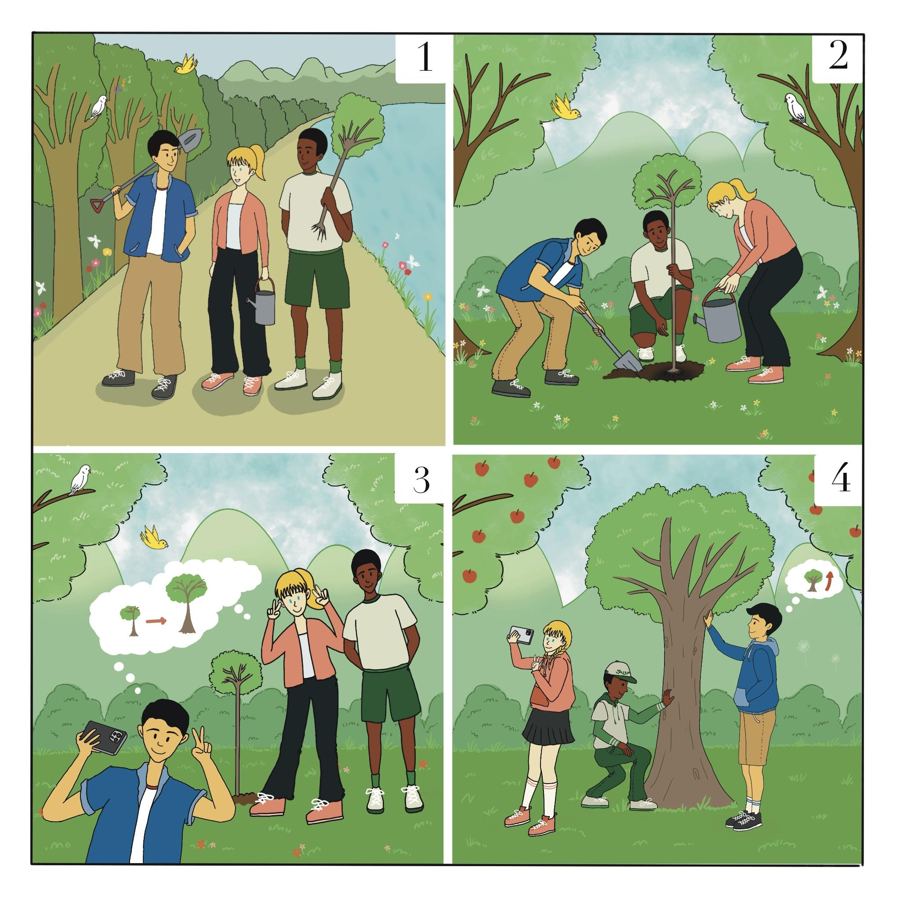
写 2Writing Part 2 · Picture-based / topic essay
Format: write a short essay (100+ words based on 4 pictures, or 200+ words on a given topic) within the time limit.
1Plan a simple 3-part structure before writing
Opening (introduce the situation/topic) → body (develop with 1–2 concrete points or the picture sequence) → conclusion (a short takeaway or opinion). Spend 1–2 minutes outlining mentally so you don't run out of things to say midway.
2For picture-story prompts, narrate cause → process → result
With the 4-picture format, treat it as a mini story: who/where (picture 1), what problem or action starts (picture 2), how it develops (picture 3), and the outcome/lesson (picture 4). Use time-sequence words like 先...然后...接着...最后 to connect them.
3Use a few HSK 5-level connectors to raise the register
Sprinkle in words like 不仅...而且、因此、总之、随着...的发展、值得一提的是 to sound more advanced than simple 因为/所以 chains — but only where they fit naturally; don't force them.
4Prioritize finishing over perfecting
A complete essay that meets the word count with a few minor errors scores better than a shorter, "perfect" fragment. Keep an eye on time and make sure you reach a natural conclusion rather than being cut off mid-thought.
★General Exam-Day Strategy
1Manage time by section, not by question
With 35 minutes for 35 reading questions, aim for roughly 1 minute/question on Parts 1–2 so you leave enough time for the denser Part 3 passages.
2Transfer answers to the answer sheet during listening, not after
You get extra time at the end of the listening section specifically to transfer bubbled answers — use it, but also mark your booklet in real time so you're never relying purely on memory.
3Build vocabulary breadth over grammar depth
At HSK 5, recognizing more of the 1,600-word list has a bigger score impact than mastering every grammar nuance, since reading and listening both hinge on vocabulary recognition speed. Use the Vocabulary tab's search/filter to drill words by part of speech.