Everything you need to know about HSK 3 and the cumulative vocabulary from levels 1–3.
300
HSK 1 words
200
HSK 2 words
500
HSK 3 words
1,000
Total cumulative words (HSK 1–3)
60%
Minimum score to pass
3
Sections: Listening · Reading · Writing
💡 HSK 1 Strategy: Master the 300 core words. Focus on greetings, numbers, dates, basic questions (吗/呢/吧), and simple sentence patterns. These form the backbone of everything above.
💡 HSK 2 Strategy: Build on HSK 1 with 200 more words. Learn aspect markers (了/过/着), directional complements, and comparison structures (比). Expand time expressions and common verbs.
💡 HSK 3 Strategy: Focus on the 500 new words. Master 把-sentences, result complements (好/完/到/错), the 是…的 pattern, and conjunctions (因为…所以…, 虽然…但是…). Practice paragraph-level writing.
HSK 1–3 Vocabulary
Search and filter the vocabulary by Chinese, pinyin, or English meaning.
#
Hanzi
Pinyin
Meaning
Example
Type
Level
HSK 1–3 Grammar Points
Key structures, sentence patterns, and categories covering all three levels. Level shown on each card.
How a Chinese Sentence Is Built
Core Chinese Sentence Template
Subject + Time + Place + Adverb + Verb + Object + Complement
1
The verb is the skeleton
Every Chinese sentence is organized around its main verb. Before analyzing or building a sentence, find the verb first — everything else (subject, time, place, adverbs, object) is positioned relative to it.
2
The subject comes first
The doer of the action opens the sentence. The only thing that can come before the subject is a time expression that frames the whole sentence (e.g. 昨天,他去了学校 — "yesterday" can lead).
3
Time before place, both before the verb
我昨天在学校学习。 Time (昨天) comes before place (在学校), and both come before the verb (学习). This order is rigid in Chinese — unlike English, where time/place phrases can trail at the end of a sentence.
4
Adverbs sit directly before the verb
也/都/已经/还/才/就/只 and similar adverbs always come immediately before the verb they modify — never after it.
他已经吃了。✓ — 他吃了已经。✗
5
Special structures override the default order
把 and 被 sentences reshape the standard S+V+O pattern: 把 → Subject + 把 + Object + Verb + Result; 被 → Subject + 被 + Agent + Verb + Result. Recognizing these patterns is more useful than trying to force every sentence into plain SVO.
Measure Words
Measure word + noun form one unit
一本书 · 三次 · 两个人 A measure word never appears on its own — it always attaches directly to the noun (or verb, for action-measure words) it counts. Read and build them as a single inseparable chunk.
Putting It Together
Building the sentence piece by piece: 他 / 已经 / 把材料 / 整理好了
他已经把材料整理好了。
Subject (他) → adverb before the verb (已经) → 把-structure (把材料) → verb + result complement (整理好了). The same layering logic — subject, then modifiers, then the verb group, then what comes after it — applies whether you're reading a sentence, listening to one, or writing one from scratch.
Sample Exam
Official specimen questions for HSK 1–3, based on the 2025–12 released “新版 HSK(1–6 级)考试结构与样题示例” (new-format HSK structure & sample questions), effective from July 2026. Pick a level below.
Disclaimer: This content is compiled strictly for personal educational and study purposes. I do not claim ownership of this official exam material — all sample questions, images, and audio originate from the official HSK sample papers, and copyright belongs to chinesetest.cn (Center for Language Education and Cooperation).
Practical strategies for each part of the Listening, Reading, and Writing sections — based on the official exam structure for HSK 1–3.
HSK 1
40 questions total: Listening (20) + Reading (20). No writing section at this level.
🎧 Listening overview: 4 parts, each audio plays only once (twice for some versions) — read every answer option before the recording starts so you know exactly what to listen for.
L. Part 1
Word/phrase → 3 pictures
You hear one word or short phrase (e.g. 三个苹果) and choose the matching picture from A/B/C. Listen for the noun — it's almost always the last word spoken. Numbers + measure words (三个/一杯/两本) point straight to the picture with that quantity.
L. Part 2
Question → 3 pinyin/hanzi answers
You hear a question (e.g. 今天天气怎么样?). Scan the 3 answer options first — they're usually one adjective/phrase each. Match the question word (怎么样/什么/谁/几点) to the option type: 怎么样 → expect an adjective answer.
L. Part 3
Short dialogue → picture (A–F)
Two people exchange one line each. The picture is usually tied to a concrete noun, action, or greeting/emotion (你好/很高兴认识你 → handshake picture). Eliminate pictures that don't match the setting mentioned.
L. Part 4
Short passage + 问 → 3 answers
A 1–2 sentence statement is read, followed by a "问:" question. The answer is almost always a noun repeated word-for-word from the passage (下午我去超市 → 问去哪里 → 超市). Listen for the location/time/object noun near the question focus.
📖 Reading overview: 4 parts, no audio — work quickly through the easy matching parts first (1–3) to save time for Part 4.
R. Part 1
Pinyin+hanzi sentence → picture (A–F)
Read the sentence aloud in your head using the pinyin to confirm meaning, then match its key noun/verb to a picture. Ignore adjectives — the noun/verb is what the picture shows (我很喜欢这本书 → picture of a book/person reading).
R. Part 2
Question/statement → matching response
Match a question to its logical reply, or a statement to its logical reaction. Question-word cues matter: 吗 → expect 是/不是 or 好的/不用 style replies; 呢/怎么样 → expect an opinion or fact.
R. Part 3
Fill the blank (A–F word bank)
A sentence has one blank; choose the correct word from 6 options. Check the word class first (noun/verb/particle) — most wrong options are the right meaning but wrong part of speech, so grammar position eliminates half the choices instantly.
R. Part 4
Short sentence → "★ 想知道什么?" (3 options)
Read what the speaker says, then identify what they're really asking about (时间/名字/房间号, etc.). The trigger word usually gives it away directly — 几点了 → 时间.
HSK 2
60 questions total: Listening (20) + Reading (20) + Writing (10). Writing is introduced at this level.
L. Part 1
Sentence → 3 pictures
Similar to HSK1 Part 1 but the audio is a full sentence, not just a word. Focus on the verb + object combo (坐公交车去上班 → bus picture), not every word in the sentence.
L. Part 2
Dialogue → picture (A–F)
A short exchange between two speakers; match to one of 6 pictures. The picture usually reflects the second speaker's line (often the answer/preference), so weight the second line more heavily than the first.
L. Part 3
Dialogue + 问 → 3 answers
Longer 2–4 line dialogues followed by a comprehension question. The correct answer often paraphrases the dialogue rather than repeating it word-for-word, so listen for meaning, not just matching sounds.
R. Part 1
Sentence → picture (A–F)
Same logic as HSK1 Part 1 reading, but sentences now include time/frequency words (每个星期六...打篮球). Match the core action, not the time expression.
R. Part 2
Fill the blank (A–F word bank)
Watch for grammar markers that need a specific word type: 了/已经...了 sentences often need a quantity/degree word like 多 (我来这里已经三年多了). Read the whole sentence first, not just around the blank.
R. Part 3
Match statement/question to logical response
Longer than HSK1 Part 2 — passages can be a full mini-exchange. Track who is speaking and match tone: a question needs an answer, a statement often needs a reaction or follow-up.
R. Part 4
Short passage → ★ comprehension question (3 options)
The passage gives one clear fact; the correct option restates it, while wrong options twist or invert a detail (e.g. swap "喜欢" for its opposite). Re-read the exact clause the question targets before choosing.
W. Part 1
Select the missing character component
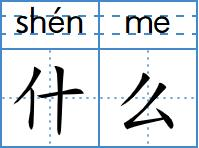
You're shown a character being built (e.g. 亻+ 么 → 什么) and must pick the correct missing piece/component from the options. Learn common character components (亻,氵,讠,忄, etc.) and which words they typically appear in.
W. Part 2
Write the character for a pinyin cue
A sentence has a pinyin word in parentheses; write the correct hanzi. Context always disambiguates homophone pinyin (e.g. chá in "你想喝( )还是喝咖啡" must be 茶, not 查) — use the surrounding sentence, not the pinyin alone.
HSK 3
70 questions total: Listening (30) + Reading (30) + Writing (10). Passages get longer and more paraphrased — direct word-matching stops working as well from here on.
L. Part 1
Dialogue → picture (A–F)
One exchange, matched to a picture. At this level pictures can represent a profession, situation, or relationship rather than a physical object — listen for context clues (职业/地点/关系), not just nouns.
L. Part 2
Dialogue + 问 → 3 answers
Answers are frequently synonyms or paraphrases of what's said (住院了 said directly, or described as "去医院照顾她" and you infer 住院了). Build a small mental synonym list as you study: 高兴≈开心, 便宜≈不贵, etc.
L. Part 3
Monologue/passage + 问 → 3 answers
A short descriptive passage (weather, a place, a habit) followed by one question. Mentally note each fact as a keyword while listening (season → adjective pairs); the question usually targets exactly one of those pairs.
R. Part 1
Match statement to logical response
Longer, more indirect than HSK1–2: a question like "经理怎么不在办公室?" pairs with an explanation, not a yes/no ("他休假了,你有事可以给他发邮件"). Look for cause-and-effect logic between the two halves.
R. Part 2
Fill the blank (A–F word bank, 2 sub-sets)
Two groups of 5: single sentences and short dialogues. For dialogues, the blank often needs a word that reflects agreement/plan-making (一块儿/一起) — read both speakers' lines before choosing.
Passages can carry 1–2 questions each. Read the question(s) before the passage so you know what to hunt for. Correct answers usually paraphrase (兴趣是最好的老师 → A "不难坚持"), so match meaning rather than searching for identical characters.
W. Part 1
Write the character for a pinyin cue
Same skill as HSK2 Part 2 but sentences are longer. Identify the grammatical role of the blank first (adverb/particle/noun) — that narrows the character before you even think about the pinyin sound.
W. Part 2
Build a sentence from a word + picture
You're given one vocabulary word and a picture; write a full grammatical sentence using both. Default to the safest template: Subject + Time + Place + 都/也 + Verb + Object (她每周末都去打羽毛球) — simple and correct beats creative and risky.
⏱️ General exam tips: Never leave a listening answer blank — you only hear each recording once (twice on some parts), so guess and move on immediately if you miss it. For reading fill-in-the-blank sections, eliminate by grammar/word-type before you even consider meaning. For writing, a short, grammatically safe sentence always scores better than a long, ambitious one with an error.